At first glance, the string of characters "Eagle Eye 2008 1080p BluRay x264-OFT" appears to be little more than a utilitarian file name—a digital label designed for sorting and searching. But to the discerning eye, it is a digital artifact, a time capsule from a specific era of home entertainment. It tells a story not just about a single film, but about the technological transition from physical media to digital files, the rise of a particular subculture, and the enduring human desire to own a pristine copy of the cinematic experience. This string is a haiku of the high-definition era, encoding the film’s identity, its technical specifications, and the community that preserved it.
Next comes the technical manifesto: This is a promise of fidelity. The "1080p" signifies a vertical resolution of 1080 pixels, the gold standard of the late-2000s for High Definition, offering a progressive scan (the 'p') that renders motion smoothly. The source, "BluRay," is even more significant. In 2008, Blu-ray was the victor in a brutal format war against HD DVD. To see "BluRay" in a file name was to invoke an image of the physical disc itself—shiny, blue-laser-read, and legally purchased. It assures the downloader that the raw material is not a degraded television broadcast or a shaky theater camcording ("CAM"), but a direct rip from the highest-quality consumer media available. The "1080p BluRay" pairing is a quality seal, a digital notary stamp authenticating the file’s noble lineage.
In conclusion, the file name "Eagle Eye 2008 1080p BluRay x264-OFT" is far more than a technical label. It is a layered text, a piece of modern digital archaeology. It speaks of the film’s thematic core (surveillance and automation), the physical media it transcended (Blu-ray), the computational science that miniaturized it (x264), and the community that curated it (OFT). In an age of effortless streaming, such file names represent a past era of active, forensic media consumption—where watching a movie required not just a click, but a comprehension of resolution, codecs, and release hierarchies. It is the poetry of piracy, the grammar of gathering, and a fleeting, perfect snapshot of how a generation learned to own their own high-definition dreams.






No unuseful, duplicated, overridden, or longhand CSS. CSS Scan runs hundreds of real-time advanced optimizations on the code to make it shorter, crystal clear, and prettier. Exactly the way you like it.
Understand how everything works without wasting time hunting through infinite CSS rules on the browsers' Dev Tools.
Get all the active styles on the fly and finish your work faster.
Use shortcuts to work with it even quickier.
If you want to copy the CSS of this element right now, it's a pain. With CSS Scan, you just click, and it's yours. It copies all child elements, pseudo-classes and media queries. Create your perfect page.


1. Open the extension
Go to any website and click on the extension icon on your browser’s toolbar to open it.
button
.edit-btn
92.1×40.8
2. Hover over any element
Hover any element and you’ll instantly get their CSS code. Inspect, debug, and understand the styling on the fly.
Copied to clipboard!
3. Click to copy
Click to copy the code, or press the space bar to pin and edit. Copy thousands of elements with a single click.

A Card Title
dribbble.com
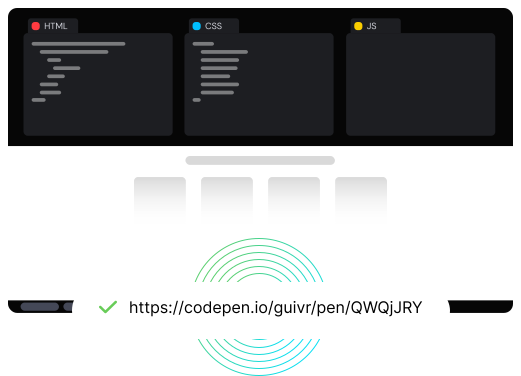
Extract the HTML and CSS of elements and all its child elements (as whole components).
You can save these Codepen snippets on the cloud and start your collection of beautiful elements that you can use on your projects from today on.
To be able to export an element, first pin the CSS window by pressing the space bar.
WordPress, Wix, Squarespace, Shopify, React, etc. CSS Scan runs on the browser as an extension so it works on any website, any theme and even works offline!
Choose your favorite: Chrome, Firefox, Safari, and Edge. Internet Explorer maybe never.


At first glance, the string of characters "Eagle Eye 2008 1080p BluRay x264-OFT" appears to be little more than a utilitarian file name—a digital label designed for sorting and searching. But to the discerning eye, it is a digital artifact, a time capsule from a specific era of home entertainment. It tells a story not just about a single film, but about the technological transition from physical media to digital files, the rise of a particular subculture, and the enduring human desire to own a pristine copy of the cinematic experience. This string is a haiku of the high-definition era, encoding the film’s identity, its technical specifications, and the community that preserved it.
Next comes the technical manifesto: This is a promise of fidelity. The "1080p" signifies a vertical resolution of 1080 pixels, the gold standard of the late-2000s for High Definition, offering a progressive scan (the 'p') that renders motion smoothly. The source, "BluRay," is even more significant. In 2008, Blu-ray was the victor in a brutal format war against HD DVD. To see "BluRay" in a file name was to invoke an image of the physical disc itself—shiny, blue-laser-read, and legally purchased. It assures the downloader that the raw material is not a degraded television broadcast or a shaky theater camcording ("CAM"), but a direct rip from the highest-quality consumer media available. The "1080p BluRay" pairing is a quality seal, a digital notary stamp authenticating the file’s noble lineage. Eagle Eye 2008 1080p BluRay x264-OFT
In conclusion, the file name "Eagle Eye 2008 1080p BluRay x264-OFT" is far more than a technical label. It is a layered text, a piece of modern digital archaeology. It speaks of the film’s thematic core (surveillance and automation), the physical media it transcended (Blu-ray), the computational science that miniaturized it (x264), and the community that curated it (OFT). In an age of effortless streaming, such file names represent a past era of active, forensic media consumption—where watching a movie required not just a click, but a comprehension of resolution, codecs, and release hierarchies. It is the poetry of piracy, the grammar of gathering, and a fleeting, perfect snapshot of how a generation learned to own their own high-definition dreams. At first glance, the string of characters "Eagle
Get ready to join 20,000+ professional web developers from 116 countries using CSS Scan every day to deliver world-class websites.
on Gumroad
Watch WPTuts' in-depth review of CSS Scan (8:37)
"This was an easy buy"
"It's a very useful Chrome/FF extension for me"
"Very useful! I do not even count the time I had to inspect each element"
"After seeing the benefits of CSS Scan there's no way I could go back to Inspecting elements through dev tools. It's a game changer"
"The best developer-productivity product of 2019. Should be a browser default!"
"CSS Scan by @gvrizzo: Hover over any element and copy its entire CSS rules with a single click 😍😍😍 So useful for frontend work"
"This tool is insane. Instabuy."
"I was told "but there are free funky extensions that tell you the CSS". Yeah. There are. And they don't evolve. CSS Scan does, and that is why I don't mind paying!"



Life-time license
$120 $79
One-time payment.
Limited to 2 browsers simultaneously.
🎁 Save 34% - Independence Day of Ghana Deal - only until March 13
Translations: Chinese (Amelia and Qianfei), Korean (정석원), Swedish (@Habbe), French (@Joulse_), German (@leoffard), Indonesian (@shinatakashi and @jetroidmakes), Vietnamese (@FancaSn1), Dutch (@Aidenbuis), Spanish (@inelnuno), Arabic (@alisumait), Russian (@sanches_free), Polish (@nerdontour), Hindi (@ashishgapat), Tamil (@anirudh24seven), Italian (@melilli_marco and @StErMi), Lithuanian (@karolis_sh), Bulgarian (@byurhanbeyzat), Serbian (@aleksa.piljevic), Malay (@wfxyz), Croatian (@VladoDev), Japanese (@HiYukoIm), Persian (@Noorullah_Ah), Romanian (@AlinaCSava), Telugu (@mksrivishnu). Logo: @salatielsq.
God Bless Us
 Loading demo... Please wait