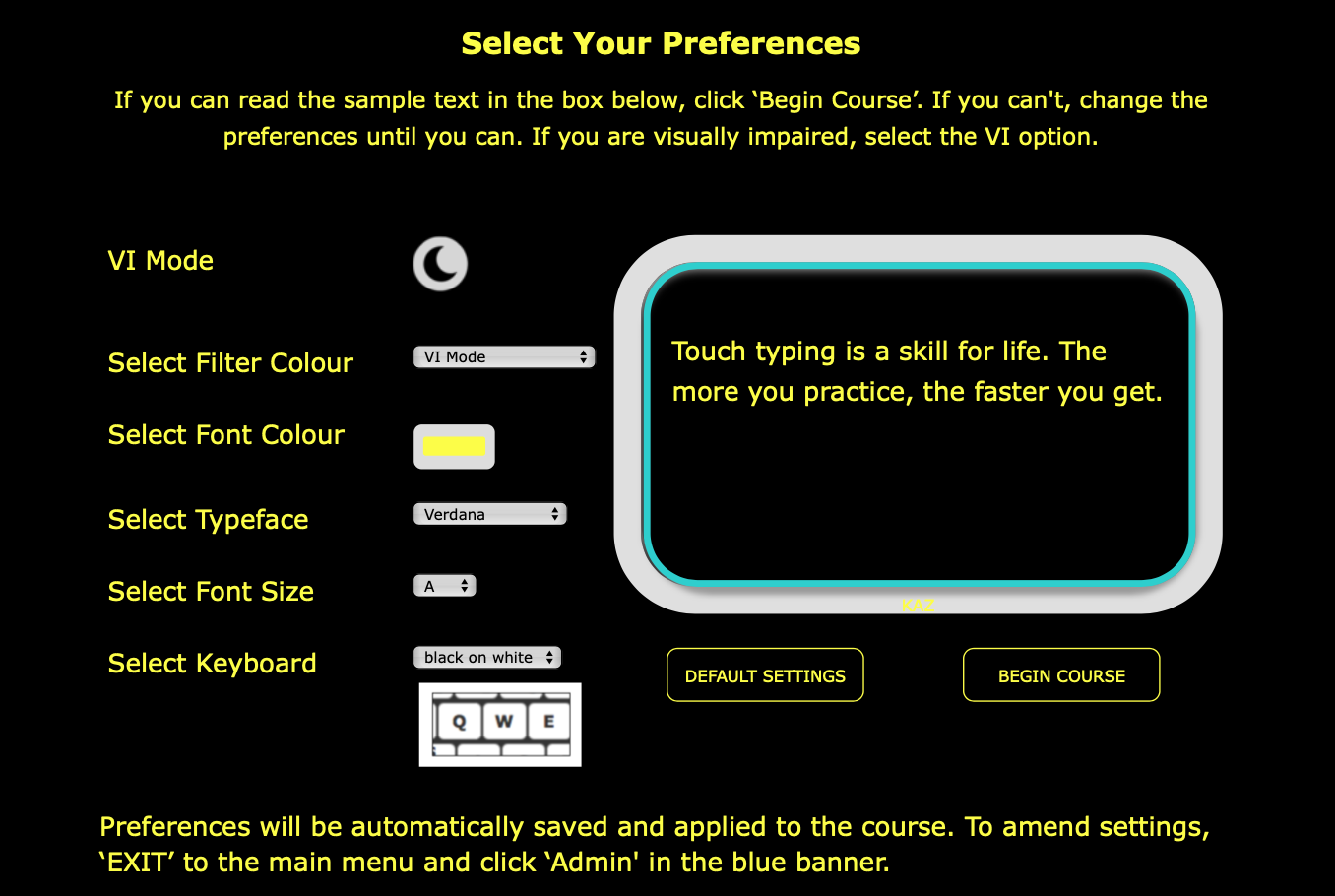
Touch Typing Software for the Visually Impaired & Blind
Specialised edition developed with advice and guidance from the
Thomas Pocklington Trust
Compatible with:
JAWS and other screen readers
Dolphin SuperNova and other magnification software/hardware
Google and other captioning software
Learning to touch type is considered one of the most beneficial skills for visually impaired and blind individuals. This is because it allows them to transfer their thoughts easily and automatically onto a screen. It provides them with an invaluable tool and asset for independent working and communicating.
Learning to touch type at any age can dramatically boost confidence, self-belief and independence. However, teaching learners with visual impairment at an early age can drastically transform their experience whilst at school and in FE/HE. It puts them on a more even standing with their sighted peers and opens doors to new career opportunities.
Achieving muscle memory and automaticity when touch typing increases efficiency and productivity. However, most importantly, it frees the conscious mind to concentrate on planning, composing, processing and editing, greatly improving the quality of the work produced.
The KAZ Course
The KAZ course is a tutorial and is designed to be used independently or with minimum supervision. However, a structured lesson plan is available in Administrators’ admin-panels should they wish to teach the course during lessons.
The course consists of five modules:
Module 1– Flying Start - explains how the course works, teaches the home-row keys, correct posture whilst sitting at the keyboard, and explains the meaning, causes, signs, symptoms and preventative measures for Repetitive Strain Injury.
Module 2– The Basics - teaches the A-Z keys using KAZ’s five scientifically structured and trademarked phrases.
Module 3– Just Do It - offers additional exercises and challenge modules to help develop ‘muscle memory’, automaticity and help ingrain spelling.
Module 4– And The Rest - teaches punctuation and the number keys.
Module 5– SpeedBuilder - offers daily practice to increase speed and accuracy.
J. Cross, Department of Ludocritical Studies
Stealth mechanics, neoliberalism, surveillance studies, IO Interactive, ludonarrative dissonance, 2007 cultural moment. Author’s note: This paper is a fictional academic exercise inspired by the prompt. No actual hitmen were consulted in its writing.
The Silent Algorithm: Neoliberal Paranoia and the Aesthetics of the Invisible Man in Hitman: Blood Money (2007)
The game’s climax—the “Requiem” funeral—subverts the player’s expectation of heroic closure. Agent 47 appears dead, only to rise and slaughter his observers. We interpret this not as juvenile revenge fantasy but as a rejection of biopolitical legibility. The state (embodied by the FBI and a rival agency) wishes to categorize, bury, and archive 47. His resurrection is the ultimate neoliberal fantasy: the asset that cannot be liquidated, the independent contractor who outlives the firm. In the 2007 context—weeks before the iPhone’s release and the explosion of location tracking—this moment celebrates the paranoid hope that one can always step outside the grid.
Every mission in Blood Money is structured as a freelance gig. The player receives a briefing, a monetary advance, and a target. There are no intrinsic rewards for mercy; the system only pays out for elimination. We read this as a gamification of zero-hour contracts. Agent 47’s silent, efficient kills mirror the ideal neoliberal worker: productive, affectless, and untraceable. Failure (detection, collateral damage) reduces the “payout” – a direct simulation of performance-based wage theft. The game’s infamous “Accident” system (making murders look like boiler explosions or falling chandeliers) further represents the ideological demand that labor be not only productive but invisible to the social safety net.
Blood Money ’s most innovative feature is its post-mission newspaper, which dynamically rewrites the story based on player chaos. A clean, silent run produces a minor footnote; a massacre produces front-page panic. This metagame mechanic forces the player to internalize the assassin’s paranoia: every action is potentially archival. In 2007, with the rise of social media (Facebook had just opened to the public) and omnipresent CCTV, the newspaper serves as a prescient model of algorithmic reputation management. Agent 47 is not a hero but a system maintenance tool—and the newspaper is the audit log.
Hitman Agent 47 2007 Page
J. Cross, Department of Ludocritical Studies
Stealth mechanics, neoliberalism, surveillance studies, IO Interactive, ludonarrative dissonance, 2007 cultural moment. Author’s note: This paper is a fictional academic exercise inspired by the prompt. No actual hitmen were consulted in its writing. hitman agent 47 2007
The Silent Algorithm: Neoliberal Paranoia and the Aesthetics of the Invisible Man in Hitman: Blood Money (2007) No actual hitmen were consulted in its writing
The game’s climax—the “Requiem” funeral—subverts the player’s expectation of heroic closure. Agent 47 appears dead, only to rise and slaughter his observers. We interpret this not as juvenile revenge fantasy but as a rejection of biopolitical legibility. The state (embodied by the FBI and a rival agency) wishes to categorize, bury, and archive 47. His resurrection is the ultimate neoliberal fantasy: the asset that cannot be liquidated, the independent contractor who outlives the firm. In the 2007 context—weeks before the iPhone’s release and the explosion of location tracking—this moment celebrates the paranoid hope that one can always step outside the grid. We interpret this not as juvenile revenge fantasy
Every mission in Blood Money is structured as a freelance gig. The player receives a briefing, a monetary advance, and a target. There are no intrinsic rewards for mercy; the system only pays out for elimination. We read this as a gamification of zero-hour contracts. Agent 47’s silent, efficient kills mirror the ideal neoliberal worker: productive, affectless, and untraceable. Failure (detection, collateral damage) reduces the “payout” – a direct simulation of performance-based wage theft. The game’s infamous “Accident” system (making murders look like boiler explosions or falling chandeliers) further represents the ideological demand that labor be not only productive but invisible to the social safety net.
Blood Money ’s most innovative feature is its post-mission newspaper, which dynamically rewrites the story based on player chaos. A clean, silent run produces a minor footnote; a massacre produces front-page panic. This metagame mechanic forces the player to internalize the assassin’s paranoia: every action is potentially archival. In 2007, with the rise of social media (Facebook had just opened to the public) and omnipresent CCTV, the newspaper serves as a prescient model of algorithmic reputation management. Agent 47 is not a hero but a system maintenance tool—and the newspaper is the audit log.
Copyright KAZ Type Limited 2025. KAZ is a registered trade mark of KAZ Type Limited.
Developed by : STERNIC Pvt. Ltd.